
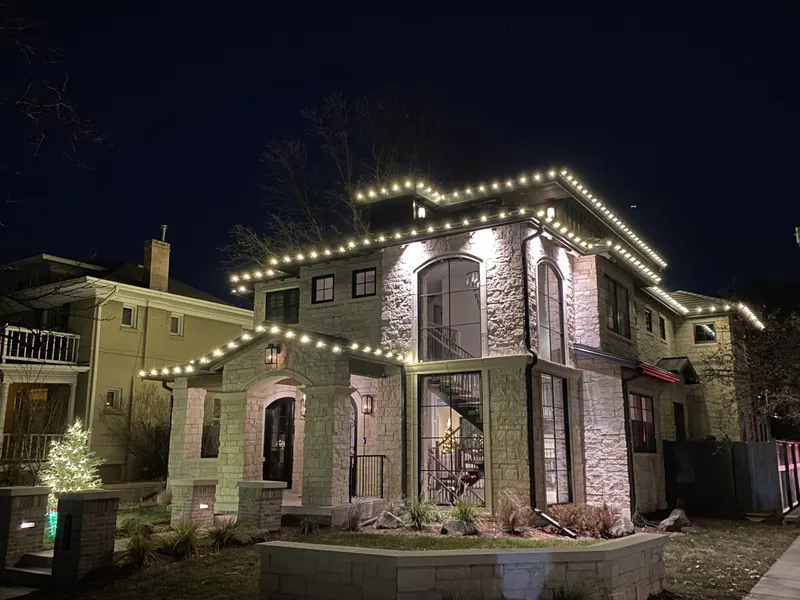
Seasonal lighting goes up each fall and comes down after the holidays, with nothing permanently attached to your home. Permanent lighting mounts a track of LEDs to your fascia or gutters and stays there year-round.
Permanent systems can work well when they're installed with care, but they cost more up front and stay exposed to Colorado sun, hail, snow, and ice all year. For most Denver homeowners, seasonal lighting is the simpler, lower-risk choice: no holes in the house, a lower cost year over year, and repairs handled for you.
Permanent holiday lighting has become a popular pitch over the last few years, and it's easy to see why. Lights you never have to hang sound great. But a system bolted to your roofline for ten or more years is a very different commitment from a display that's designed, installed, and stored for you each season.
Here's an honest look at both, so you can decide what fits your home, your budget, and how much you want to think about your lights in July.
What's the difference?
Seasonal (traditional) holiday lighting
Lights are clipped onto your gutters and shingles each fall, run on a timer through the holidays, and come down after the new year. With a professional service like ours, the design, install, in-season service, takedown, and off-season storage are all handled for you.
Permanent holiday lighting
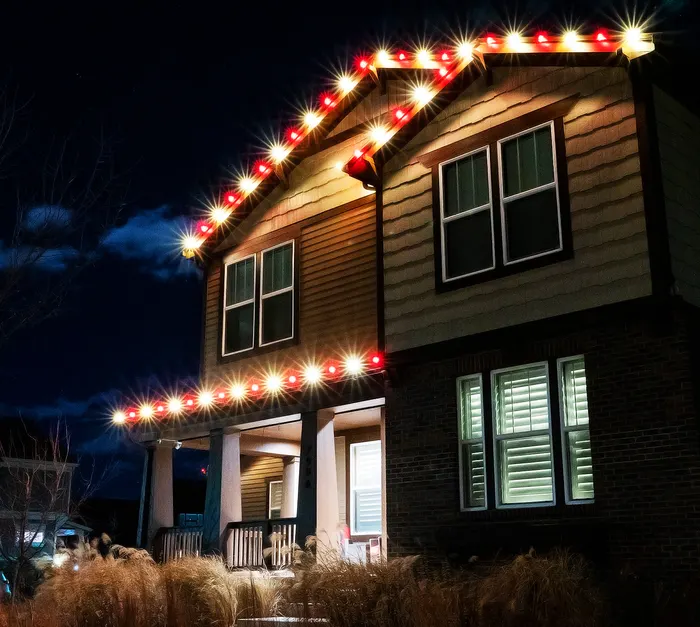
A channel or track is fastened along your fascia, soffit, or gutter line, and LED pixels or pucks sit inside it year-round. A controller box and power supply, usually managed through an app, let you change colors and patterns for different holidays and events.
Permanent vs. seasonal, side by side
| Factor | Seasonal | Permanent |
|---|---|---|
| Attachment | Clips only. Nothing permanent on your home. | Track fastened to fascia, soffit, or gutters. |
| Upfront cost | Lower. You pay for one season at a time. | High initial investment for the system and install. |
| Year over year | Predictable, with service included each season. | Repairs and out-of-warranty parts are on you. |
| Weather exposure | About two months a year, then stored indoors. | Twelve months a year of sun, hail, snow, and ice. |
| Repairs | One phone call; we swap the section. | Diagnosing a failed node in a track can be slow. |
| Other home projects | Nothing to work around after takedown. | Painting, gutters, and roofing work around the track. |
| Off-season look | A clean roofline, as built. | Track and fixtures visible all year. |
| Technology | A photocell timer. No app or Wi-Fi needed. | Often depends on an app, Wi-Fi, and the maker's servers. |
Why we install seasonal lighting
We chose to specialize in seasonal displays because they're better for the home and easier on the homeowner. Here's what that means for you.
Non-invasive, every time
We never attach anything permanent to your home. No drilled holes, no screws in the fascia, no adhesive on the trim. Lights go up with clips and come down clean, leaving your roofline exactly as we found it.
Quick, easy install, takedown, and storage
Your display goes up in the fall, comes down after the holidays, and spends the off-season stored at our facility. You never untangle a strand or find room for it in the garage.
Warranty and maintenance every year
Each season starts with lights we've checked over in storage. If a section goes dark, call us and we'll come out and take care of it. If and when corrosion, damage, or a failure happens, it's handled at no cost to you.
Nothing to work around
Once the lights come down, your home is just your home. Painting the trim, replacing gutters, or re-roofing doesn't mean removing, protecting, or reinstalling a lighting track.
Energy efficient
We use energy-efficient C9 LED bulbs and 5mm LED string lights on a photocell timer, so your display only runs from dusk, and only during the season.
Lower cost year over year
There's no large upfront investment in a system you'll own for a decade. You pay for the season you want, with design, service, takedown, and storage included. See what installation typically costs.
Common problems with permanent lighting
A well-built permanent system can look sharp. But these systems live on your home year-round, and the issues below come up often, especially when the install isn't done with precision.
Installation issues
- Track and wire placement. Crooked tracks, visible wires crossing the roof, and track colors that don't match the trim can hurt curb appeal all year, not just in December.
- Holes in gutters and fascia. Drilling into gutters or fascia can affect drainage, invite leaks, and in some cases void a gutter or roofing manufacturer's warranty.
- Control box placement. Power supplies and controllers tucked into damp soffits or unconditioned attics can be exposed to moisture and overheating.
Weather and wear in Colorado
- UV and sun. Denver's elevation means strong sun. Year-round exposure breaks down wire insulation and plastic lenses over time.
- Freeze, thaw, and hail. Front Range winters swing from warm afternoons to frozen nights, and spring brings hail. Temperature swings and moisture speed up corrosion at connection points, which shows up as dead sections or flickering.
- Adhesive failures. Systems that rely on double-sided tape instead of mechanical fasteners can sag or fall after a few seasons of weather.
Electrical and technology issues
- Voltage drop. Long LED runs can dim, flicker, or shift color toward the end of a run unless power is properly calculated and injected along the way.
- App and Wi-Fi dependency. Schedules and color themes often live in a proprietary app. If the maker drops support or its servers go offline, smart features can stop working.
- Hard-to-get service. Finding and replacing one failed node in a sealed track can be tedious, and service gets harder if the original installer is no longer in business.
Cost, HOA, and resale
- High upfront cost. Permanent systems require a large initial investment compared with seasonal lighting, even if they save some labor over many years.
- HOA rules. Many Denver-area HOAs regulate exterior lighting, including brightness, colors, and fixtures that stay up year-round. Seasonal displays come down when the season ends, and we design around your HOA's rules.
- Resale and appearance. Visible tracks and puck lights can clash with clean architectural lines. Whether permanent lighting looks polished or out of place depends heavily on how well it's concealed.
When permanent lighting can make sense
Permanent lighting isn't wrong for everyone. If you want accent lighting all year, for game days, the Fourth of July, or every holiday on the calendar, and you're planning to stay in your home for many years, it may be worth a look. If you go that route, ask any installer about:
- How the track is fastened, and whether it goes into your gutters or fascia
- Whether the track is color-matched and the wiring fully concealed
- Where the controller and power supply will live, and how they're protected
- How voltage drop is handled on long runs
- Whether the lights work without the app, Wi-Fi, or the maker's servers
- What the warranty covers, for how long, and who services it
- Whether your HOA allows year-round fixtures
How to decide
If you want a beautiful holiday display without changing your home, without a large upfront investment, and without owning the repairs, seasonal lighting is the better fit. Every display we install starts with a free, in-person estimate, where we design around your home, your HOA, and your budget.
Common questions
Do permanent Christmas lights damage your home?
Are seasonal Christmas lights cheaper than permanent lights?
What happens if my seasonal lights stop working?
Can I paint my house or replace gutters with permanent lights installed?
Do you install permanent lighting?
Ready to plan a display that leaves your home as you found it?
Get a Ballpark Price